
America's Toughest College Basketball Prep League?
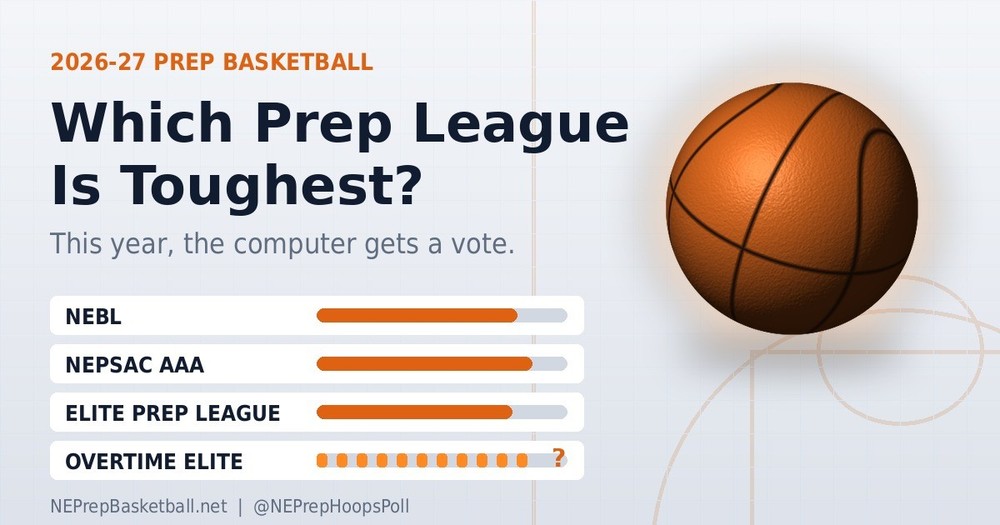
Which Prep League Is Toughest? This Year, the Computer Gets a Vote
Ask ten college coaches to name the toughest prep league in the country and you'll get plenty of arguments, but four names come up in most of them: the New England Basketball League (NEBL), the New England Preparatory School Athletic Council (NEPSAC) AAA division, the Elite Prep League (EPL), and Overtime Elite (OTE). This season, for the first time, there may be a way to settle it with numbers.
Rankings in parentheses are final 2025-26 NEPrepBasketball.net national computer rankings.
The NEBL's case
The case for the NEBL starts with last season's national computer rankings. This season's NEBL lineup includes the program that finished No. 1 in the country last season, Newman School National (MA). It also includes last season's No. 3 program, in a new form: Putnam Science Academy closed its doors this year, and its prep basketball program moved to Woodstock Academy (CT), where it now plays as Hellstar OTE. Add Cushing Academy (No. 5) and Darrow School (No. 14), and the NEBL begins this season with four programs that finished last season in the national top 15.
The league's depth goes beyond the top tier. CATS Academy Prep Boston (No. 38), Brimmer & May (No. 52), and South Kent (No. 66) complete the core. Tilton School (No. 70) joins in year two under Hall of Famer Marcus O'Neil, and Hoosac School AAA (No. 91) joins with a roster loaded with FIBA national-team talent. New Hampton (No. 12) is the notable departure.
Last season, the nine current NEBL members that were ranked averaged a national rank of about 38. In a field of hundreds of prep programs, a league whose programs averaged a top-40 finish doesn't leave many nights off.
The newcomer: Masters Academy International
The tenth NEBL team has no ranking history, but it may be the most intriguing addition to the league. Masters Academy International (MAI) is building a sports boarding school in Stow, MA, designed to combine elite athletics, academics, and student life in a single program. Its basketball program has drawn national attention before playing a single game. MAI's NEBL entry is its national-level Prep team, coached by former Kansas guard Naadir Tharpe, a veteran prep coach who also serves as the school's co-director of player development. A start-up joining one of the country's deepest leagues in its first season is a bold move, and MAI has the staff and the recruiting momentum to make it more than a gamble. With no results to go on, the Prep team is a true unknown, and that makes it one of the most interesting teams for the computer to measure this year.
NEPSAC AAA's case
NEPSAC AAA overlaps heavily with the NEBL: Newman, Darrow, CATS, South Kent, and Hoosac play in both. AAA also adds New Hampton (No. 12), Vermont Academy (No. 20), Bridgton Academy (No. 29), St. Thomas More (No. 31), and perennial power Brewster Academy. Last season, AAA's nine ranked teams averaged about 34, which makes it at least as strong on paper.
The Elite Prep League's case
Any version of this debate has to include the Elite Prep League. Thirteen of its 15 current members finished last season in the national top 100, led by Hargrave Military Academy (VA) at No. 9, Mt. Zion Prep (MD) at No. 15, Western Reserve Academy (OH) at No. 16, and Spire Academy Post Grad International (OH) at No. 19, with Massanutten Military Academy (No. 23), Highland School (No. 26), and Athletes in Action (No. 28) close behind. Fork Union Military Academy (No. 39), St. James Performance Academy (No. 49), Andrews Osborne Academy (No. 51), and IX International (GA) (No. 69) added depth in the middle of the pack.
Last season, the NEBL's members had more teams at the very top, but the EPL's had more depth, with seven top-30 finishes to the NEBL's four. The EPL's average rank of about 39 was essentially tied with the NEBL's 38. The league may get even stronger this season, because Spire's International roster looks good enough to push for a top-10 ranking. Its geographic reach, stretching from Ohio and Pennsylvania through Virginia and the Carolinas to Georgia and Ontario, means its teams cross paths with programs from all over the prep map, and that makes the computer's math considerably more reliable.
A caveat about last season's numbers
One reason this question never quite gets settled: the teams themselves don't stay the same long enough. Prep rosters at this level turn over heavily from year to year. Many players stay only one season, and many of them are post-graduates taking a gap year after standout high school careers to add strength, sharpen their skills for the college game, and get in front of more college scouts. A program that finished in the national top 10 in March can show up in November with almost an entirely new rotation, and a brand-new program like Masters can enter the picture overnight. Last season's rankings tell us which programs have the coaching, the recruiting pull, and the schedules to compete at the top. They can't tell us how this year's version of each team will play.
Why the postseason can't settle it
You might expect March to answer the question. It doesn't, because the top prep postseasons never bring all these teams together. The OTE postseason includes only OTE teams. The National Prep School Championships are limited to traditional, brick-and-mortar prep schools. The basketball-only programs and the academies with online academic models that now make up much of the national prep landscape aren't in either bracket. Each postseason crowns a champion within its own group, but none of them compares across groups.
The national computer rankings are the one measure that does. They take in the full range of programs, including traditional boarding schools, programs with online academic components, and basketball-focused prep academies. They don't try to sort teams by educational model. They measure one thing: how well each team plays on the court against everyone it faces.
The wild card: a new kind of Overtime Elite
That leaves one major gap, and it happens to be the most interesting challenger.
Overtime Elite launched in Atlanta in 2021 as something prep basketball had never seen: a league that signed elite 16- to 19-year-olds, at first with professional salaries and later with scholarships that protected college eligibility. Its players trained and competed out of a 103,000-square-foot facility on OTE-owned teams with names like City Reapers, Cold Hearts, and YNG Dreamerz. The results speak for themselves. Amen and Ausar Thompson, Alexandre Sarr, and Rob Dillingham all came through OTE on their way to the NBA, and 25 OTE alumni played in the 2026 NCAA Tournament. FaZe won last season's OTE title.
This season OTE looks very different. This spring, OTE moved to a national prep league model built around established prep programs, and DraftExpress reported that the league would stop operating its own teams and housing players year-round. Member schools pay no entry fee, and OTE covers their travel and apparel. In return, it rebrands each program with a new OTE team name, logo, and colors. That's how Putnam Science's program, now based at Woodstock Academy, came to play as Hellstar.
The talent level is hard to argue with. When Florida power Southeastern Prep joined OTE in April, the league gained three more of the top five prospects in the class of 2027, giving it all five. Former NBA player Landry Fields now runs league operations. OTE co-founder Farzeen Ghorashy has said that nearly every school OTE would want is now asking to join.
That shift is exactly why this year matters for the computer. Under the old model, OTE's in-house teams played mostly against each other, with too few games against computer-ranked opponents for the algorithm to rate them reliably, so they were left out of last season's rankings. As OTE has added nonconference games against ranked prep teams, that problem has gone away. For 2026-27, every OTE team will be included in the national computer rankings.
Where the math comes from: crossover games
Cross-league games are what make the computer's math meaningful, and this season there should be plenty of them. Hellstar will likely be the most important single data point, since it plays both an NEBL and an OTE schedule. The EPL's wide geographic reach adds more connections, as its teams meet opponents from the other three leagues throughout the season.
The math gets stronger still every time a team from one of these leagues plays a national power that faces teams from several of them. Blair Academy (NJ), IMG Academy (FL), Academy of Central Florida, and Link Academy (MO), last season's No. 2, No. 4, No. 6, and No. 7 programs, all play schedules like that. Springfield Commonwealth Academy (MA) (No. 34), built by master program builder Tony Bergeron, also appears headed for a very high ranking this winter, and its top team plays an especially useful set of crossover games. Each of those games helps link the leagues together, and the more links there are, the more the computer's verdict can be trusted.
The verdict comes in March
For the past few years, "toughest league in the country" has been a matter of opinion. This season, the one scorekeeper that sees every kind of program gets to weigh in. With heavy roster turnover everywhere, a revamped OTE, and a new program at Masters, nobody has a head start. We'll be watching to see how it all shakes out.